Steel Section Export Cargo Insurance Complete Guide: Avoid Risks of Rust Damage, Shortage & Cargo Loss During Ocean Shipment
 By
/ 2026-10-21
I-beams, channel steel, angle steel, H-beams and steel plates are heavy bulk commodities. During ocean transportation, inland transit and terminal loading/unloading, they are highly vulnerable to rusting, dents and deformation, short-landing, broken strapping and overboard loss.
Many overseas buyers mistakenly believe the carrier’s liability covers all cargo damage, or assume insurance automatically covers all losses under CIF terms. They end up facing claim rejection and huge financial losses after damage occurs.
As a steel section exporter, we have sorted out core concepts of marine cargo insurance for steel export, insurance selection, liability under Incoterms, common pitfalls and claim procedures. This practical guide helps you plan transport risks before signing contracts for steel section purchases.
1. Unique Risks for Steel Section Transportation
Unlike general cargo, steel risks mainly fall into these categories:
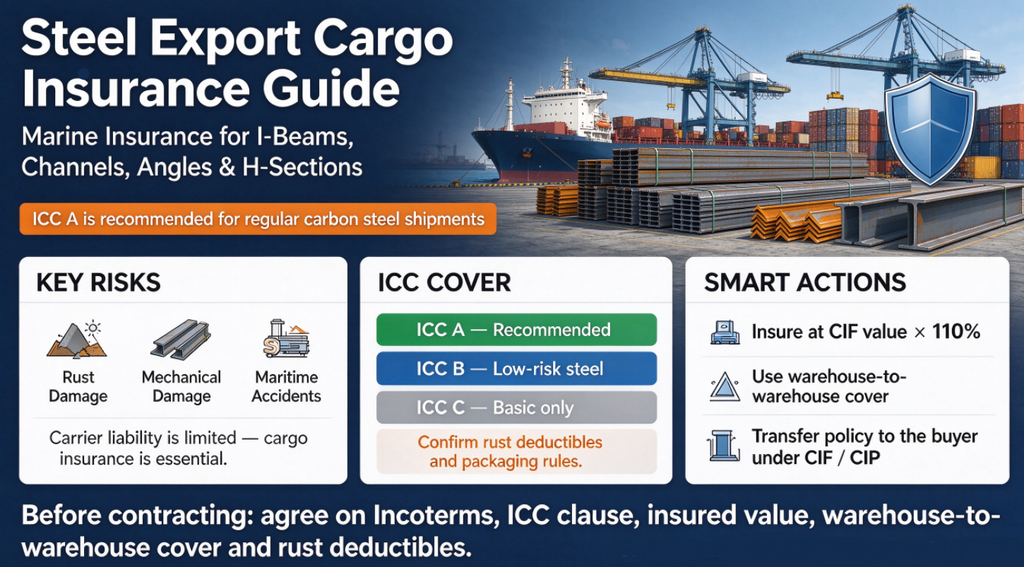
- Rust damage: In high-humidity and salt-spray ocean environments, broken packaging, rain exposure and open-air storage at port yards easily cause rust spots on carbon steel sections. This is the most frequent claim type for steel cargo. Many policies set separate deductibles for rust damage.
- Mechanical damage: Improper lifting points and loose strapping lead to bent, deformed or end-damaged steel sections that cannot be used for engineering projects.
- Short-landing / shortage: Steel bundles may be opened, stolen or missing at transshipment ports, resulting in quantity shortages.
- Maritime accidents: Grounding, collision, severe weather and fire causing total or partial loss of the whole shipment.
Important reminder: Carriers (shipping lines) have very limited liability. Under bill of lading terms, carriers only cover major accidents with limited compensation. Rust, shortage and handling damage are mostly excluded from carrier liability and cannot replace cargo insurance.
2. ICC Three Main Clauses: How to Choose for Steel Export
The internationally adopted Institute Cargo Clauses (ICC) are divided into ICC A, B and C, which are the standard policy system for steel export.
- ICC A (All Risks) — Preferred for Steel Section Exports It provides the broadest coverage. Subject to exclusions stated in the policy, it covers physical damage, rust, shortage and breakage caused by any external risks during transit. ✅ Suitable for: Carbon steel I-beams, channel steel, angle steel, engineering orders, CIF / CIP contracts and long-distance shipments with transshipment. ❗ Note: All Risks does not mean every loss is covered. Inherent vice, natural wear and tear, market price decline, delay in transit and wilful misconduct are excluded. Rust damage is covered as an external risk, though rust deductibles are usually specified in the policy.
- ICC B (With Particular Average, W.P.A.) Covers losses caused by listed natural disasters and transport accidents, including seawater and rainwater damage. It does not cover theft, short-landing or general handling dents. Suitable for heavy thick-wall steel with low-risk shipping routes.
- ICC C (Free From Particular Average, F.P.A.) Basic coverage only for major accidents such as fire, sinking and collision. It excludes partial losses caused solely by ordinary natural disasters, as well as rust and shortage. Only for low-value scrap steel, not recommended for regular steel section orders.
Optional Add-On Risks
- War risk & Strike risk: Recommended for unstable routes such as the Red Sea and certain African ports. These need to be purchased separately.
- Fresh water & rain damage risk: If ICC A is not selected, add this rider to cover rust caused by rainwater.
3. Incoterms 2020: Who Buys Cargo Insurance? (Key Contract Point)
Most trade disputes stem from confusion over insurance liability. Clarify responsibilities before contract signing:
- ✅ CIF / CIP: The seller (exporter) arranges insurance. The insurance policy can be transferred to the buyer. The minimum requirement under traditional CIF is ICC C. However, for steel cargo, we strongly recommend writing ICC A in your contract to avoid claim denial for rust damage after arrival.
- ✅ DAP / DDP: The seller takes full responsibility and needs full warehouse-to-warehouse insurance from origin warehouse to the buyer’s destination warehouse.
- ✅ FOB / CFR / EXW / FCA / CPT: The buyer purchases marine cargo insurance. The seller only delivers goods; the buyer bears transit risks.
Advice for your website visitors: Under FOB terms, many overseas buyers forget to buy insurance. If maritime incidents happen, all losses fall on the buyer. We recommend arranging insurance in advance.
Warehouse-to-Warehouse Clause
A qualified marine cargo policy applies warehouse-to-warehouse cover: insurance takes effect when goods leave the origin warehouse, covering sea transport, transshipment and inland trucking until the cargo arrives at the buyer’s final warehouse at destination.
⚠️ Common coverage gap: If the policy only covers port-to-port instead of warehouse-to-warehouse, rust occurring during factory-to-port haulage or open-air port storage will not be compensated. Always confirm this clause for steel shipments.
4. Practical Insurance Tips for Steel Shipment (Avoid Common Pitfalls)
4.1 Calculation of Insured Value
International practice: CIF cargo value × 110% (product cost + freight, plus 10% margin to cover expected profit and claim handling fees).
- Under-insurance: Insurers will compensate proportionally after loss, and the balance of loss must be borne by buyer or seller.
- Over-insurance: Insurers only settle based on actual cargo value, no extra payout, and you waste premium.
4.2 Packaging & Deductibles for Steel Cargo
- Carbon steel policies normally apply absolute deductibles for rust damage, e.g. 0.5% ~ 1% of loss per shipment. Stainless steel usually has more lenient deductible terms.
- Packaging affects claims: Steel sections must be bundled and reinforced with steel strapping, with end protection if required. Insurers may reject claims if packaging is seriously inadequate.
- Before application, fully inform insurers of material grade (S235JR / S355JR etc.), packaging method, loading port, destination port, transshipment port and transport route.
4.3 Assured & Transferable Policy
For CIF orders, the policy shall be transferable. The insurance certificate is sent together with bill of lading, commercial invoice and packing list. The buyer can file claims directly as the transferee after receiving goods.
5. Full Claim Procedure for Steel Cargo Damage
- Notify insurer/insurance broker promptly within 3 working days once damage is found. Do not delay reporting.
- Preserve the scene. Do not clean, cut or move damaged steel sections. Take full photos and videos: outer packaging, strapping, rusted areas, deformation, shipping marks and B/L number.
- Request a cargo damage survey report and short-landing certificate from the carrier or terminal operator.
- Appoint a third-party surveyor for on-site inspection and loss assessment.
- Prepare full claim documents: insurance policy, commercial invoice, packing list, ocean bill of lading, survey report, photos & videos of damage, carrier damage certificate.
- Submit claim application after loss assessment and wait for settlement.
Top reasons for claim rejection: Late notification, defective packaging, rust existing before shipment (inherent vice), no warehouse-to-warehouse coverage, under-insurance.
6. FAQ (High-Frequency Questions for SEO)
Q1: Can shipping line’s insurance replace marine cargo insurance for steel?
A: No. Shipping lines have low liability limits under B/L. They only offer limited compensation for major maritime accidents. Rust, handling damage and shortage are generally excluded from carrier liability. Separate cargo insurance is mandatory.
Q2: Does ICC A cover all rust on steel sections?
A: ICC A covers rust caused by external factors during transit. Rust existing before shipment, natural ageing and inherent defects of goods are not covered. Rust deductibles are normally stated in the policy.
Q3: Under FOB terms, does the seller need to buy insurance for the buyer?
A: Per Incoterms, the insurance obligation belongs to the buyer under FOB. As your supplier, we can assist you in connecting with insurance brokers and recommend insurance plans to reduce procurement risks.
Q4: How much is the insurance premium?
A: Premium depends on cargo value, shipping route, insurance type, cargo type and past claim records. Premium for bulk steel ocean shipment is generally from 0.0X% to 0.X% of cargo value. Quotation is available upon order details.
7. Conclusion
Steel sections are high-value engineering bulk goods with long ocean transit times. Risks from salt spray, handling and transshipment cannot be ignored. Cargo insurance is not an extra cost, but the basic risk control measure for your order.
Before contract signing, both buyer and seller shall reach a written agreement on Incoterms, insurance clauses, ICC coverage level, insured amount, warehouse-to-warehouse scope and rust deductibles. This is critical to avoid cross-border trade disputes.
If you plan to purchase I-beams, channel steel, angle steel and other steel sections, please contact us. We will provide matched insurance recommendations based on your loading port, destination port and trade terms.