Payment Terms for Structural Steel International Trading
 By
/ 2026-10-20
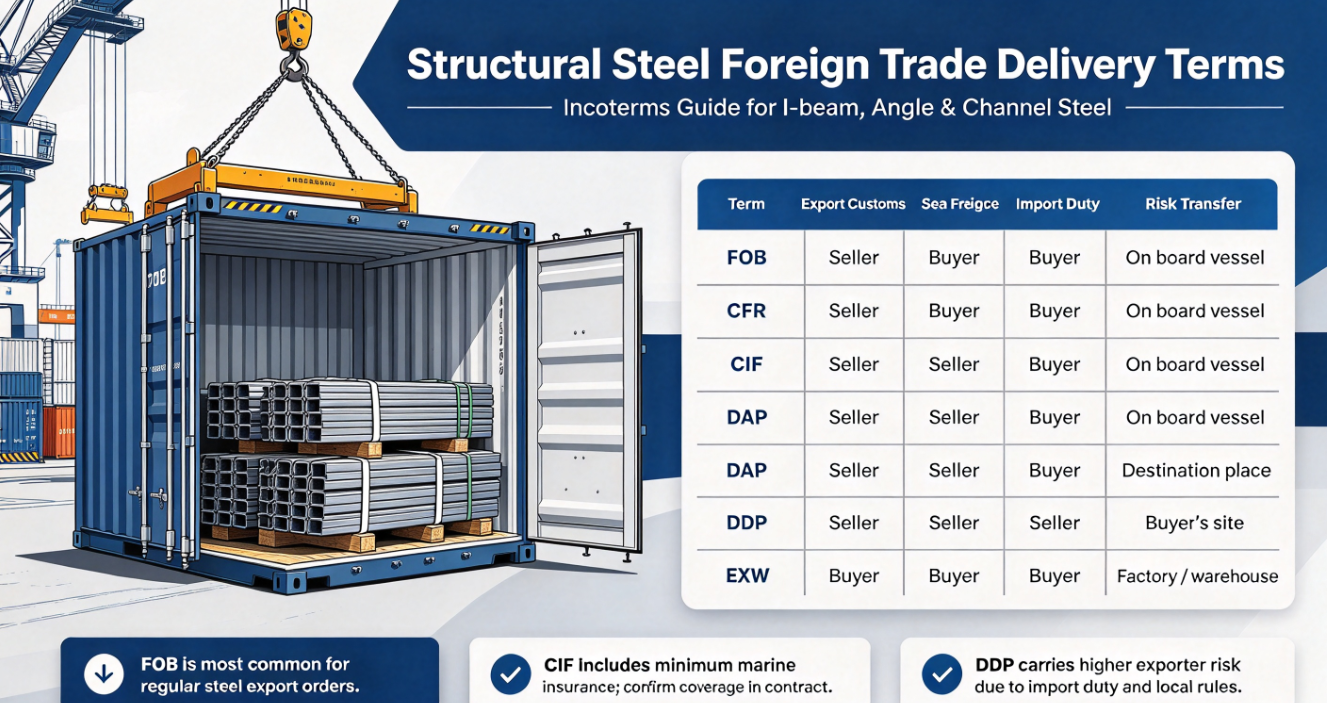
In structural steel foreign trade, delivery terms define the split of costs, risks and responsibilities between the steel seller and the overseas buyer. Choosing the wrong delivery term can lead to unexpected freight fees, cargo damage disputes, customs clearance risks or demurrage charges.
For I-beam, angle steel, channel steel, H-beam and other heavy steel sections, the most widely used Incoterms are listed below.
1. EXW (Ex Works)
- Rule: Buyer arranges all logistics. Seller only makes goods ready at the factory/warehouse.
- Seller’s duty: Produce, bundle and mark steel sections; ready for pickup at factory.
- Buyer’s duty: Pick up goods, inland trucking, export customs declaration, sea freight, import customs, all insurance and risks.
- Best for: Buyers with a strong local logistics team.
- Note: Buyer even handles export customs clearance, which is rarely used for Chinese steel exports.
2. FOB (Free On Board)
- Rule: Seller delivers steel on board the vessel at the named port of loading. Risk transfers once goods are loaded onto the ship.
- Seller: Export customs clearance, inland truck to port, port charges, bundling & marking.
- Buyer: Book vessel, sea freight, marine cargo insurance, import customs, destination inland transport.
- Best for: Most regular steel export orders. Buyer controls shipping line.
- Note: Risk transfers after loading on vessel. If steel gets damaged during inland trucking to port, seller bears the loss.
3. CFR (Cost and Freight)
- Rule: Seller pays sea freight to destination port; risk transfers after loading on vessel.
- Seller: Export customs, inland transport, port cost + sea freight to destination port.
- Buyer: Buy marine cargo insurance, import customs and destination inland delivery.
- Difference from CIF: Insurance is buyer’s responsibility.
4. CIF (Cost, Insurance and Freight)
- Rule: Seller pays sea freight + minimum marine insurance to destination port. Risk transfers after loading on vessel.
- Seller: Export customs, inland trucking, port charges, sea freight + ICC(C) cargo insurance.
- Buyer: Import customs clearance, destination port unloading and inland transport.
- Note: Insurance coverage is minimum. If buyer needs full cover ICC(A), they must specify it in contract.
5. DAP (Delivered At Place)
- Rule: Seller delivers steel to the named destination place (warehouse, project site). Risk transfers before unloading.
- Seller: Full transport chain: export customs, sea freight, destination port handling, inland transport to buyer’s site.
- Buyer: Import customs duty, import VAT, unloading cost at destination.
- Best for: EPC project buyers who want door delivery but handle import tax themselves.
6. DDP (Delivered Duty Paid)
- Rule: Maximum obligation for seller. Steel delivered to buyer’s site, all import duty & VAT paid by seller.
- Seller: Export customs, sea freight, destination inland transport, import customs clearance, import duties and taxes.
- Buyer: Only receive goods and arrange unloading.
- Warning: High risk for steel exporter. Many countries have complicated import tax rules and inspection requirements. Not recommended for long-distance steel orders.
7. FCA (Free Carrier)
- Rule: Suitable for container truck, railway or multimodal transport. Risk transfers when goods are handed over to the carrier.
- Widely used for rail freight to Central Asia (CIS countries, GOST steel orders).
Quick Comparison Table
| Incoterm | Export Customs | Sea Freight | Cargo Insurance | Import Duty | Risk Transfer Point |
|---|---|---|---|---|---|
| EXW | Buyer | Buyer | Buyer | Buyer | Factory warehouse |
| FOB | Seller | Buyer | Buyer | Buyer | On board vessel |
| CFR | Seller | Seller | Buyer | Buyer | On board vessel |
| CIF | Seller | Seller | Seller | Buyer | On board vessel |
| FCA | Seller | Buyer/Buyer | Buyer | Buyer | Handover to carrier |
| DAP | Seller | Seller | Seller | Buyer | Destination place (before unloading) |
| DDP | Seller | Seller | Seller | Seller | Destination place (after customs) |
How to Pick the Best Delivery Term for Steel Section Orders
- FOB: Recommended for most normal steel exports. Balanced risk, buyer controls shipping schedule.
- CIF/CFR: Use when buyer asks seller to book sea freight, but remind buyer to confirm insurance scope.
- DAP: For EPC project clients who want door delivery. Clearly separate import tax responsibility.
- DDP: Use cautiously. Import tax and local inspection rules can create high unexpected costs.
- EXW: Rare for Chinese steel exports; most buyers prefer the seller handles export customs.
Important Notes for Steel Section Trade
- All Incoterms follow Incoterms® 2020. Always write the version on the sales contract.
- Clearly define loading/unloading cost in contract. Heavy steel bundles may incur extra crane/unloading fees.
- For long I-beam / H-beam breakbulk shipment, confirm port handling capacity before selecting terms.
- MTC, packing list and commercial invoice must match the delivery term for customs clearance.
Conclusion
FOB, CFR and CIF are the mainstream delivery terms for structural steel export. DAP and DDP are used for project-based door delivery. Before signing the contract, both parties must clarify cost allocation, risk transfer and customs responsibilities for I-beam, angle steel and channel steel.
If you need a quotation for structural steel sections, we can offer flexible delivery terms such as FOB, CIF or DAP according to your project requirements. Contact us now.