Steel Sections & Classification Societies: A Complete Guide for Steel Export Buyers
 By
/ 2026-10-21
When purchasing steel sections for shipbuilding, offshore platforms, marine projects and vessel repair, buyers often require classification society-approved steel. Many importers confuse “class certified steel” with an ordinary mill test certificate (MTC). Non-compliant steel will be rejected during shipyard inspection, causing project delays and huge financial losses.
As a steel section supplier, we explain what classification societies are, their role in steel production, certification requirements, common classes and critical points for your steel purchase contracts.
1. What is a Classification Society?
A classification society (often shortened to “class”) is an independent, non-governmental third-party organization. It sets safety standards for ships, offshore structures and marine materials.
Their core job:
- Establish rules for the design, materials and construction of marine vessels and offshore assets
- Audit steel mills and inspect steel products
- Issue approval certificates for qualified factories and materials
- Survey ships and offshore structures for compliance during construction and service
Important: Classification societies are not government authorities. Their certificates are widely recognized by shipyards, ship owners and marine insurance companies worldwide.
2. Why Marine Steel Sections Need Class Approval
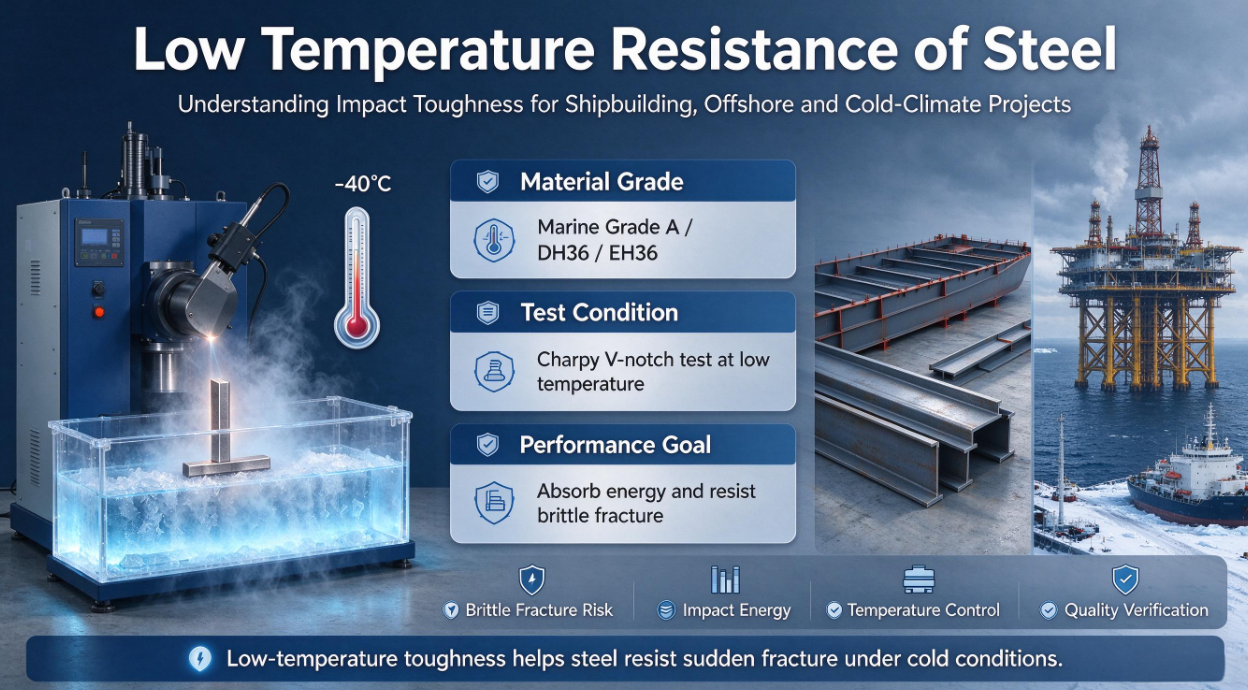
For steel used in ship hulls, decks, offshore jackets and marine structural parts, raw material quality directly affects vessel safety. Ordinary carbon steel (S235JR / S355JR) is suitable for general construction. But for marine projects, steel sections must pass the class approval to guarantee impact toughness, grain structure and welding performance under harsh ocean environments.
If steel sections are not class-approved:
- Shipyard will reject delivery
- Cannot be used for vessel construction
- Marine underwriters may refuse insurance coverage for non-class compliant marine steel
3. Major International Classification Societies (Common in Steel Trade)
- DNV (Det Norske Veritas) – Norway, most widely used for offshore & shipping projects
- LR (Lloyd’s Register) – UK, popular for commercial vessels
- BV (Bureau Veritas) – France, common for bulk carriers
- ABS (American Bureau of Shipping) – USA, widely used for US-related marine projects
- CCS (China Classification Society) – China, for Chinese flagged vessels & offshore projects
- RINA (Registro Italiano Navale) – Italy
- KR (Korean Register) – South Korea
- NK (Nippon Kaiji Kyokai / ClassNK) – Japan
Key note: One mill can hold approvals from multiple classification societies. We can supply steel sections certified by the class specified in your project tender.
4. Class Approved Steel vs Ordinary MTC (Mill Test Certificate)
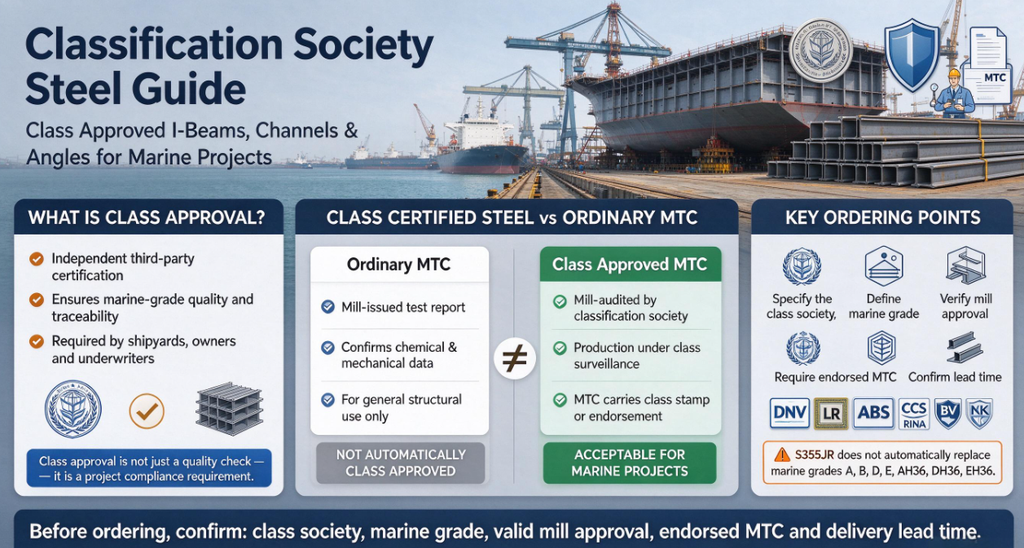
Many buyers mix these two documents up. ✅ Ordinary MTC (Mill Test Certificate) Issued by the steel mill, only confirms chemical composition and mechanical properties of the batch. Valid for general construction, but not automatically class-approved.
✅ Class Approved MTC / Class Certificate The mill has passed the audit of the classification society. The steel is produced under the class’s supervision. The MTC will be marked with the class logo and class rules reference. This certificate is accepted by shipyards and vessel owners.
Critical trap: An MTC with qualified test data does NOT equal class certification. Always check whether the steel mill has valid class approval and the MTC carries class endorsement.
5. Key Points When Ordering Class Approved Steel Sections
- Confirm which classification society you require. Specify DNV / LR / ABS / CCS etc. clearly in your purchase contract. Do not simply write “marine grade steel”.
- Specify marine steel grade. Marine structural steel grades: A, B, D, E, AH36, DH36, EH36 etc. These are different from standard S235/S355 structural steel.
- Check the mill’s valid class approval certificate before ordering. Request the mill’s class approval document. Verify its validity and product scope (whether I-beam, channel, angle steel are covered).
- MTC endorsement requirement: The final mill test certificate must bear the class stamp or class endorsement to prove the batch is under class surveillance.
- Lead time difference: Class-certified steel usually has a longer production lead time than regular structural steel due to stricter inspection and documentation procedures.
6. FAQ
Q1: Is a class certificate mandatory for all steel exports?
A: No. It is only required for shipbuilding, offshore platform and marine vessel projects. General building steel sections do not need classification society approval.
Q2: Can we use S355JR steel instead of DNV grade A / AH36?
A: Usually not. S355JR is normal structural steel without marine impact test requirements. It fails marine class rules and will be rejected by shipyards.
Q3: Can one batch of steel get dual class approval?
A: Yes. Some mills can produce steel satisfying two classification societies’ requirements, subject to prior agreement.
Q4: What if the MTC only has test data without a class stamp?
A: This batch is not class approved. It cannot be used for marine shipbuilding projects.
7. Conclusion
Classification society certification is a mandatory quality gate for marine steel sections. When you source steel for ship or offshore projects, clearly define the required classification society, marine steel grade and endorsed MTC in your contract. Avoid costly rejection due to misunderstanding between ordinary MTC and class-approved certificates.
Contact us if you need DNV, LR, ABS, CCS, or other class-approved I-beams, channel steel, angle steel and H-sections. We can provide qualified MTC and class documentation for your marine tender.