Hot Rolled vs Cold Rolled Steel: What Is the Difference?
 By
/ 2026-10-27
Steel is one of the most widely used construction materials worldwide. When sourcing steel sections, sheets and plates, buyers frequently encounter two core categories: hot rolled steel and cold rolled steel.
Many new buyers confuse these two terms. It is important to understand that “hot” and “cold” do not refer to the final service temperature of the steel. Instead, they describe the rolling temperature during manufacturing.
This guide breaks down their production, characteristics, advantages and suitable applications, helping you select the right material for your building, bridge, machinery and structural projects.
What is Hot Rolled Steel?
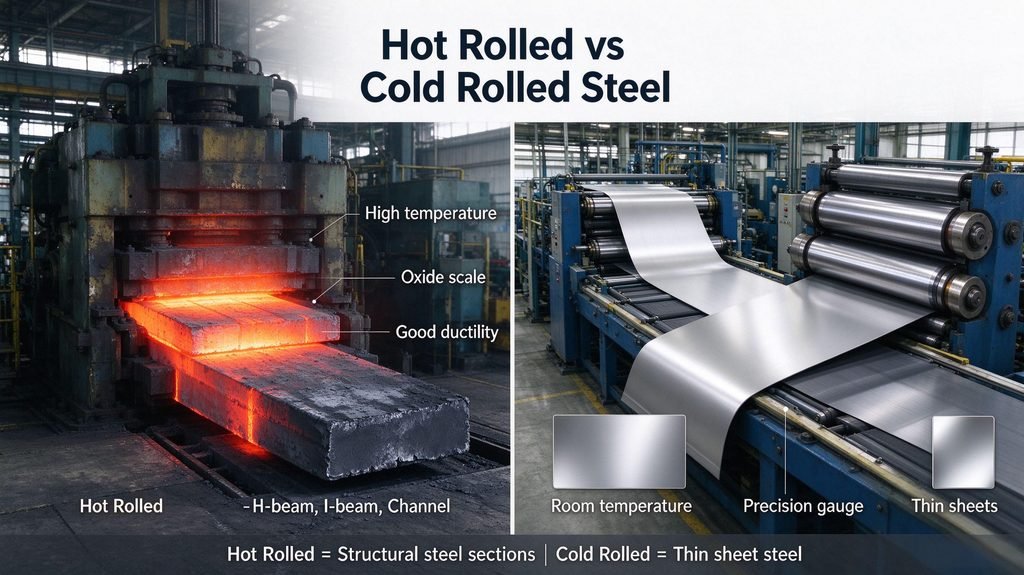
Hot rolling takes place above the steel recrystallization temperature (roughly 930°C). At this high temperature, steel becomes soft and easy to deform. Steel billets pass through rolling mills continuously to form the required profiles.
After rolling, the steel cools naturally at room temperature. Natural cooling causes slight shrinkage, which brings looser dimensional tolerances. A dark oxide layer called mill scale forms on the surface.
✅ Main features of hot rolled steel
- Rough, dark grey surface with mill scale
- Larger dimensional tolerance, less strict flatness control
- Good ductility, easy to bend and fabricate
- Lower production cost, shorter lead time
- No work hardening; balanced toughness and yield strength
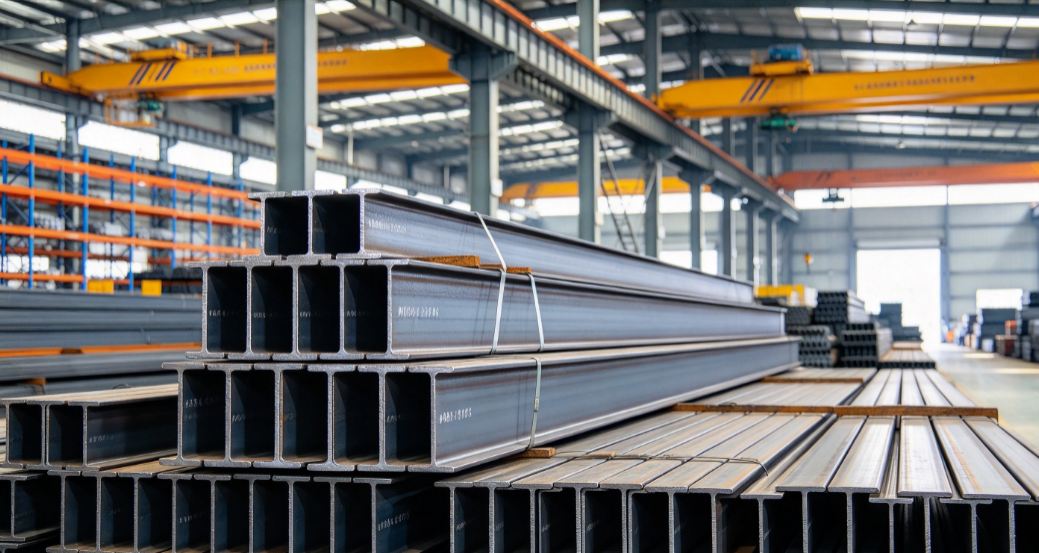
✅ Common applications Hot rolled steel is the primary choice for heavy structural sections. This includes H-beam, I-beam (IPE/IPN), channel steel, angle steel, steel plate and steel sheet piles. It is widely adopted in steel frame buildings, bridges, industrial plants, heavy equipment support frames and offshore structural components.
What is Cold Rolled Steel?
Cold rolled steel starts with hot rolled steel coils as raw material. It is re-rolled at room temperature, below the recrystallization point.
Room-temperature rolling creates work hardening: the steel becomes harder and stronger, but less ductile. Manufacturers usually add post-processing such as annealing to adjust performance. The cold rolling process removes oxide scale and achieves smooth, uniform surfaces.
✅ Main features of cold rolled steel
- Bright, clean, smooth surface, ready for painting, powder coating or plating
- Very tight dimensional tolerance, excellent flatness and straightness
- Higher tensile strength and hardness
- Limited ductility compared with hot rolled steel
- Extra processing steps lead to higher cost and longer lead time
✅ Common applications Cold rolled steel is mostly produced in thin sheets and strips. It is popular for cabinet shells, automotive body panels, electrical enclosures, furniture frames, precision stamped parts and small thin metal components.
Important note: Cold rolling is not used to produce large structural profiles such as H-beams, I-beams or heavy channels. All standard structural sections you source for construction projects are hot rolled.
Side-by-Side Comparison Table
| Item | Hot Rolled Steel | Cold Rolled Steel |
|---|---|---|
| Rolling Temperature | Above recrystallization temperature | Room temperature |
| Surface Condition | Rough, with mill scale | Smooth, oxide-free |
| Dimensional Tolerance | Loose tolerance | Tight, precise tolerance |
| Strength & Ductility | Good ductility, moderate strength | Higher hardness & strength, lower ductility |
| Cost | Lower price | Higher price |
| Typical Products | H-beam, I-beam, channel, angle, heavy plate | Thin steel coils, thin sheets, precision stampings |
| Best For | Heavy structural engineering | Thin sheet metal & precision parts |
How to Choose Between Hot Rolled and Cold Rolled Steel
Choose hot rolled steel if:
- You need structural beams, columns, channels and angle steel for construction and bridge projects
- Surface finish is not the top priority
- You want to control material cost
- You require good bending and welding performance
Choose cold rolled steel if:
- You need thin sheets with smooth surface and precise dimensions
- The part requires painting, coating or electroplating
- You need high stiffness for light, precision metal components
Frequently Asked Questions
Q1: Is cold rolled steel stronger than hot rolled steel?
Yes. Cold working hardens the steel, so cold rolled steel has higher tensile strength and hardness. However, it is less ductile and harder to bend.
Q2: Can cold rolling be used for H-beams and I-beams?
No. Standard H-beam, I-beam and channel sections are hot rolled products. Cold rolling technology is not designed for large heavy structural profiles.
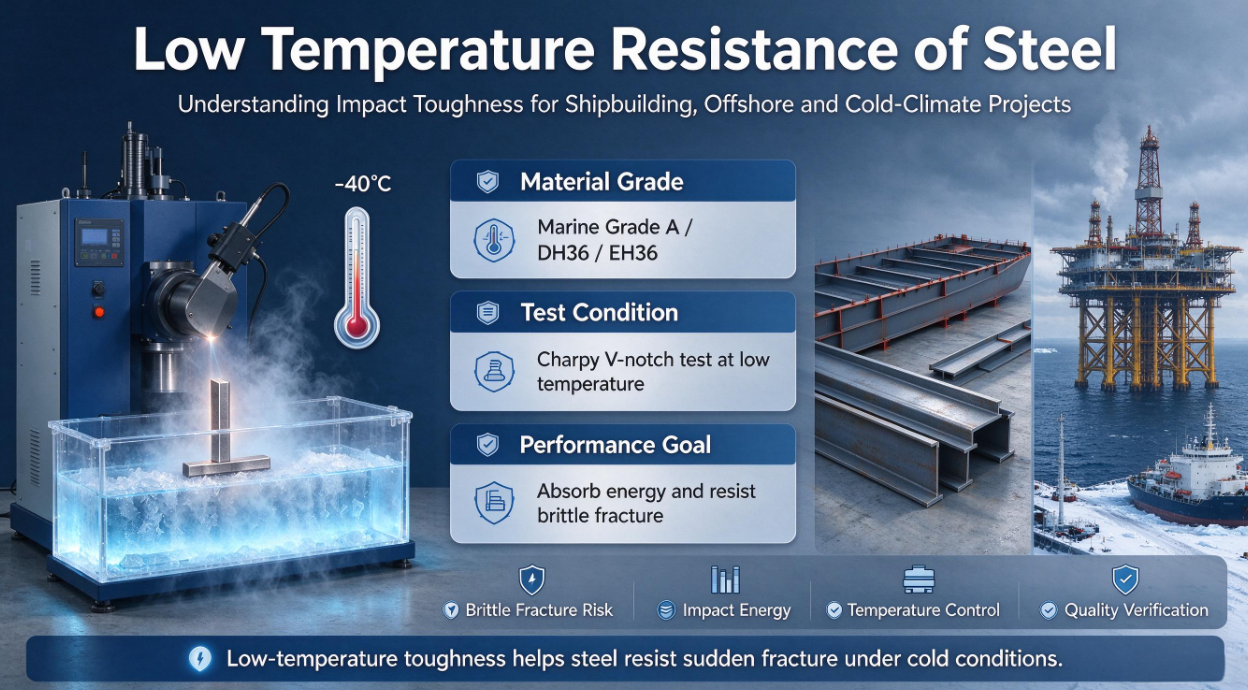
Q3: Does cold rolled steel mean it can resist low temperature better?
No. The “cold” only refers to the rolling process. Low-temperature performance depends on steel grades (such as Q355D, A572 Grade 50), not whether it is hot or cold rolled.
Final Summary
Hot rolled steel is the backbone of structural engineering, supplying heavy steel profiles for large-scale construction. Cold rolled steel is a high-precision sheet material focused on surface quality and tight tolerance.
When you source structural steel sections for your project, H-beams, I-beams, channels and angles are always hot rolled. If you need thin, smooth metal sheets for finishing and precision fabrication, cold rolled steel will be the correct option.
If you need support selecting suitable steel grades and profiles, feel free to contact our team for full specifications and MTC documents.