Seamless Pipe vs Welded Pipe: A Complete Buyer’s Guide for Steel Projects
 By
/ 2026-10-28
Steel pipes are the backbone of global industrial infrastructure. Two dominant categories are seamless pipe and welded pipe. Many fabricators, EPC contractors, steel stockists and project buyers struggle to decide which one fits their specification, budget and service conditions.
Neither option is universally better. The correct selection depends on working pressure, temperature, medium, diameter, budget and project code requirements. This guide breaks down manufacturing, performance, pros & cons, typical applications and standard references for both pipe types.
What is Seamless Pipe?
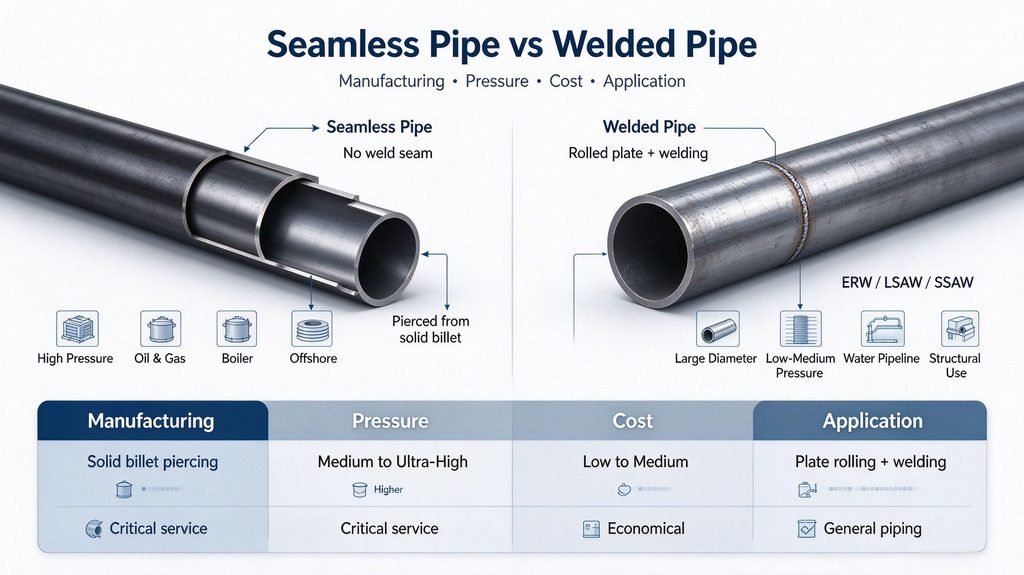
Seamless steel pipe is produced from a solid round steel billet. The billet is heated to forging temperature, pierced and elongated to form a hollow tube without any longitudinal weld joint. Further hot rolling, cold drawing or sizing processes control OD, wall thickness and straightness to final dimensions.
Because there is no weld seam, the material microstructure stays uniform across the whole pipe body. There is no heat-affected zone (HAZ) from welding, which removes the seam as a potential weak point.
Common standards for seamless pipe:
- ASTM A106 (high-temperature carbon steel seamless pipe)
- ASTM A53 Grade A / B
- ASTM A333 (low-temperature seamless pipe)
- ASTM A335 (alloy seamless pipe for high temp service)
- API 5L seamless line pipe
- EN 10216, EN 10305
Advantages of Seamless Pipe
- Higher pressure and temperature resistance, suitable for critical service
- No weld seam risk of cracking, corrosion or fatigue failure
- Better performance under sour service, hydrogen sulphide and corrosive fluid
- Joint efficiency factor E = 1.0 under ASME B31.3 piping code
- Good bending, flanging and cold forming performance
- Reliable for hydraulic, boiler, refinery and offshore piping
Limitations of Seamless Pipe
- Higher production cost and longer lead time
- Limited large-diameter options; seamless pipe is less economical above DN 500–DN600
- Wall thickness tolerance may be wider than precision welded pipe
- Less flexible for custom extra-large diameter projects
What is Welded Pipe?
Welded pipe is formed by rolling steel plate or steel coil into a cylindrical shape, then welding the edges together. Main welded types include ERW (Electric Resistance Welded), LSAW (Longitudinal Submerged Arc Welded) and SSAW / spiral welded pipe.
Modern welded pipes go through weld heat treatment, weld seam inspection, hydrostatic test, UT / RT non-destructive testing to meet international codes. High-quality welded pipes can be used for medium-pressure industrial pipelines, but the weld zone remains its key feature.
Common standards for welded pipe:
- ASTM A53 welded pipe
- ASTM A587 ERW pipe
- ASTM A358 stainless fusion welded pipe
- API 5L LSAW / SSAW line pipe
- EN 10217 welded pressure pipe
Advantages of Welded Pipe
- Lower unit cost and faster mass production
- Wide diameter range, especially large OD (suitable for water, drainage, long-distance pipeline)
- More consistent wall thickness and roundness for many sizes
- Flexible custom lengths, easy for large bulk orders
- Ideal for structural pipe, scaffolding, low-pressure fluid transmission
Limitations of Welded Pipe
- Weld seam and heat-affected zone exist; this is the main inspection focus
- Lower joint efficiency factor compared to seamless pipe
- Not recommended for ultra-high pressure, high-temperature critical service without strict NDT
- Higher seam corrosion risk if weld heat treatment is inadequate
Side-by-Side Comparison Table
| Item | Seamless Pipe | Welded Pipe |
|---|---|---|
| Manufacturing | Pierced from solid steel billet, no weld | Rolled plate/coil + longitudinal/spiral welding |
| Weld Seam | None | Yes (ERW / LSAW / SSAW) |
| Pressure Level | Medium to Ultra-High pressure | Low to Medium pressure |
| Strength & Uniformity | Homogeneous grain structure, higher safety margin | Good base metal; weld zone is the critical zone |
| Cost | Higher | Economical |
| Diameter Range | Mostly small & medium OD | Full range, dominates large diameter |
| Typical Inspection | Hydro test, dimension check, MTC | Hydro test, UT / RT weld inspection, MTC |
| Best For | Boiler, refinery, high-pressure process, offshore, hydraulic line | Water supply, drainage, structural pipe, low-pressure gas, large pipeline |
Typical Industrial Applications
Seamless Pipe Main Markets
- Oil & gas high-pressure well tubing, process piping
- Power plant boiler tubes, superheater pipes
- Refinery, petrochemical and chemical process lines
- Hydraulic cylinder tubes, high-pressure instrument piping
- Low-temperature service, sour service piping
- Offshore platform piping
Welded Pipe Main Markets
- Municipal water supply, sewage and drainage pipelines
- Low-pressure natural gas transmission
- Structural steel pipe, scaffolding, fence, building truss
- Long-distance land pipelines (SSAW spiral pipe)
- General mechanical tubing, casing for non-critical service
- Solar structure, construction and infrastructure projects
How to Choose Between Seamless and Welded Pipe
Use this simple decision checklist for your RFQ:
- Working pressure & temperature: High pressure / high temperature → seamless pipe is preferred.
- Diameter: Large diameter (DN600+) → welded LSAW / SSAW is usually the practical choice.
- Fluid medium: Sour, corrosive, hazardous fluid → seamless pipe is safer.
- Code & client specification: Many EPC or end-user specs explicitly require seamless for Class 1 critical piping.
- Budget & delivery schedule: Cost-sensitive, low-pressure general projects → welded pipe saves total investment.
- NDT requirement: If welded pipe is selected, confirm RT / UT inspection scope for weld seam.
Important note: A certified welded pipe that passes full weld inspection can perform reliably for its designed service. Welded pipe is not “inferior” — it is a cost-effective solution for its designed working condition.
FAQ
Q1: Is seamless pipe always stronger than welded pipe?
A: Under identical grade, OD and wall thickness, seamless pipe has a higher safety margin because there is no weld seam weak point. Modern qualified welded pipe can still meet its design pressure rating after NDT inspection.
Q2: Can welded pipe be used for gas and oil?
A: Yes. API 5L LSAW and SSAW welded pipes are widely used for long-distance oil and gas transmission pipelines, following strict welding and inspection standards.
Q3: Do you provide MTC for seamless and welded pipe?
A: Yes. All our pipes come with Mill Test Certificate, complying with ASTM, EN and API standards. Third-party inspection (SGS, BV) is available upon request.
Closing
Seamless pipe and welded pipe serve different engineering purposes. When your project demands maximum safety under high pressure and extreme temperature, seamless pipe is the reliable option. When you need large diameter, fast delivery and controlled cost for low/medium-pressure fluid or structural use, welded pipe is the practical solution.
If you send us your specification: OD, wall thickness, grade, standard, working pressure and application, we can recommend the most suitable pipe type and prepare formal quotation for your project.