Impact of Tariffs, Anti-Dumping Duties and Geopolitical Conflicts on Global Structural Steel Profile Export Trade
 By
/ 2026-10-29
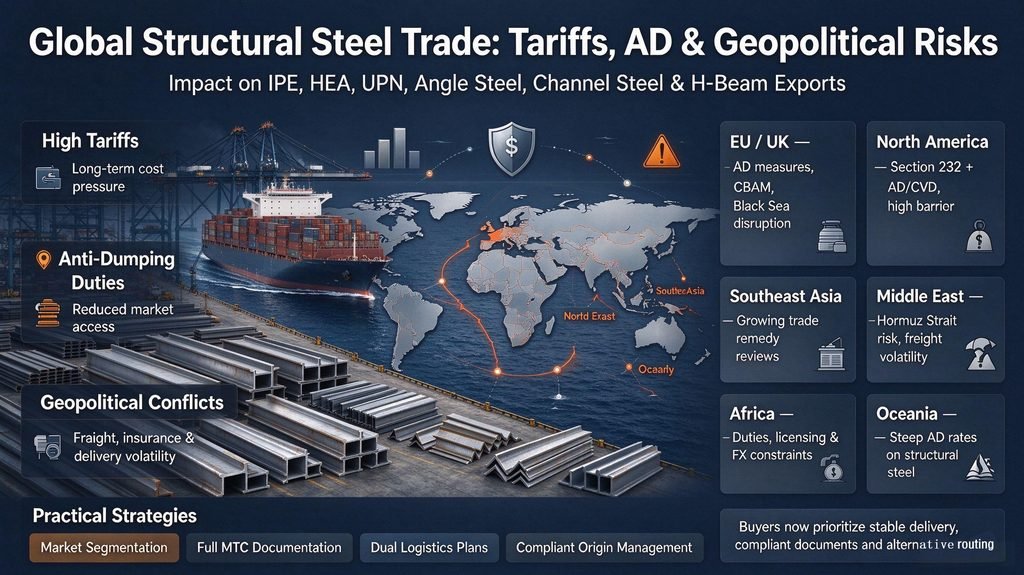
The global trade of structural steel profiles — including IPE, HEA, UPN, H-beams, angle steel and channel steel — is facing dual pressure: rising trade protectionism and volatile geopolitical risks. Long-term barriers such as high import tariffs and anti-dumping / countervailing duties compress profit margins, while regional conflicts disrupt key shipping lanes, pushing up ocean freight, insurance premiums and delivery uncertainty. Market conditions vary widely from region to region, requiring exporters and buyers to adjust procurement and logistics strategies accordingly.
Europe (EU & United Kingdom)
The European market has one of the strictest trade frameworks for imported steel. The EU maintains long-standing anti-dumping measures on Chinese H-beams and I-beams, alongside limited tariff-rate quotas and the phased implementation of the CBAM Carbon Border Adjustment Mechanism. Even shipments without anti-dumping duties must comply with carbon reporting rules, which add extra compliance costs.
Black Sea shipping routes remain restricted due to the Russia-Ukraine conflict. Vessels heading to Eastern Europe and Black Sea ports have to take longer diversion routes, leading to extended transit time and higher freight rates.
For steel traders, direct bulk exports to the EU are challenging. Valid EN standard certificates and mill test certificates (MTC) are mandatory, and only properly documented third-country processing routes can be considered, at the cost of higher overall pricing.
North America (USA, Canada, Mexico)
The United States applies the Section 232 steel tariff of 25% on most steel imports, layered with additional anti-dumping and countervailing duties covering H-beams, angles and channels. Combined duties can easily exceed 30%, eroding the price competitiveness of imported structural steel. Mexico and Canada have also launched multiple steel safeguard investigations and anti-dumping cases in recent years.
North America is now a high-barrier market. Large-volume regular orders are difficult to sustain. Most viable business is limited to small, special project requirements rather than commodity bulk steel.
Southeast Asia (Vietnam, Indonesia, Malaysia, Thailand)
Southeast Asia remains one of the key growth markets for Chinese structural steel exports, yet trade friction is accelerating rapidly. Local steel mills have expanded capacity and lobbied for trade remedies. Vietnam has imposed anti-dumping duties on H-beams and carries out regular sunset reviews. Indonesia and Thailand have opened new anti-dumping investigations on steel profiles.
A common risk here is circumvention audits. Many buyers previously sought simple repackaging or transshipment to bypass duties, but customs authorities now strictly verify melting certificates and original mill documents. Fake or low-quality transshipment arrangements frequently result in cargo detention and heavy fines.
Logistically, the Strait of Malacca route is relatively stable, with fewer sudden freight surges compared with Middle East conflict zones.
Gulf Middle East (Saudi Arabia, UAE, Qatar, Oman)
For steel exporters, the Gulf market stands out: there are no widespread heavy anti-dumping tariffs on structural steel, though selective investigations have started in the UAE. The biggest threat is not customs duties, but geopolitical disruption of critical shipping chokepoints.
Shipments passing through the Strait of Hormuz face volatile war risk surcharges and rising war insurance costs. If the strait is restricted, carriers will divert vessels around the Cape of Good Hope, adding 10–18 days of transit. During peak tension, freight rates can jump 30%–80% per ton.
Alternative logistics options include transshipment via Indian ports or inland cross-border transfer through Oman, though these solutions carry higher cost and extra clearance risks. Gulf buyers prioritise reliable delivery schedules for construction and oil & gas projects, so most are willing to evaluate both the cheaper direct route and the safer diversion plan.
Africa (South Africa, East & West Africa)
South Africa has finalised anti-dumping duties on imported steel profiles, creating a major barrier for bulk shipments. Nigeria, Kenya and other African nations enforce strict import licensing and foreign exchange controls.
East and West Africa have fewer active anti-dumping cases, but importers regularly struggle with foreign currency shortages and unpredictable customs clearance. Most cargo sails via the Cape of Good Hope, avoiding the Red Sea and Hormuz risk zones, but vessel space can be unstable.
Oceania (Australia)
Australia has imposed steep anti-dumping duties on hot-rolled structural steel products. Some rates are over 100%, supported by local domestic steel producers. This market is extremely difficult for regular bulk steel profile exports.
Eurasian Economic Union & CIS
Eurasian Economic Union members apply anti-dumping restrictions on selected steel products plus tight origin checks. The Black Sea lane is largely closed for steel cargo. Shipments to Kazakhstan and Central Asia increasingly rely on rail transport via China-Europe Railway Express instead of sea freight.
South America (Brazil, Peru, Chile)
Brazil protects its domestic steel industry with baseline import tariffs. Peru and Chile have opened anti-dumping probes on hot-rolled steel and profiles. South America is gradually moving away from being a low-tariff open market, adding more cost pressure for overseas buyers.
Key Trends for Steel Profile Exporters
- Trade protectionism is spreading from developed economies to emerging markets. After orders shift to Southeast Asia and the Middle East, local steel producers push for anti-dumping investigations one after another.
- Two separate risk categories hurt profitability: anti-dumping tariffs are long-term fixed costs, valid for 5 years or more; geopolitical conflict causes floating freight and insurance costs that make firm pricing very hard.
- Buyers no longer focus only on the lowest price. Mill test certificates, compliant origin documents, backup shipping routes and phased delivery plans have become critical selection criteria.
Practical Strategies for Structural Steel Trade
- Segment your markets: target high-value special profiles for Europe and North America, and focus bulk IPE/HEA/UPN/angle steel sales on Southeast Asia and the Middle East.
- Prepare full documentation: EN 10025 MTCs for S235JR, S275JR and S355JR grades to meet project approval requirements.
- Offer dual logistics plans for Middle East clients: direct service through the Strait of Hormuz (lower cost, higher risk) or Cape diversion / transshipment (higher cost, stable schedule).
- Avoid risky circumvention schemes such as simple repackaging to fake origin, as customs inspection standards keep tightening.
If you are sourcing structural steel profiles with reliable documentation and flexible shipping solutions, feel free to send us your inquiry.