20-Year Global Structural Steel (Section Steel) Price Trend: Key Drivers & Market Outlook
 By
/ 2026-10-22
Structural steel sections — including H-beams, I-beams, angle steel and channel steel — are the backbone of global construction, industrial fabrication and infrastructure projects. Over the past 20 years, international section steel prices have experienced dramatic boom-and-bust cycles, driven by global macroeconomics, raw material costs, China’s steel output, supply chain disruptions, energy shocks and evolving trade & carbon regulations.
For project owners, fabricators and international steel buyers, understanding these long-term cycles helps you plan procurement, manage budget risk and time purchases wisely. This article breaks down the major price phases and root causes from 2005 to today.
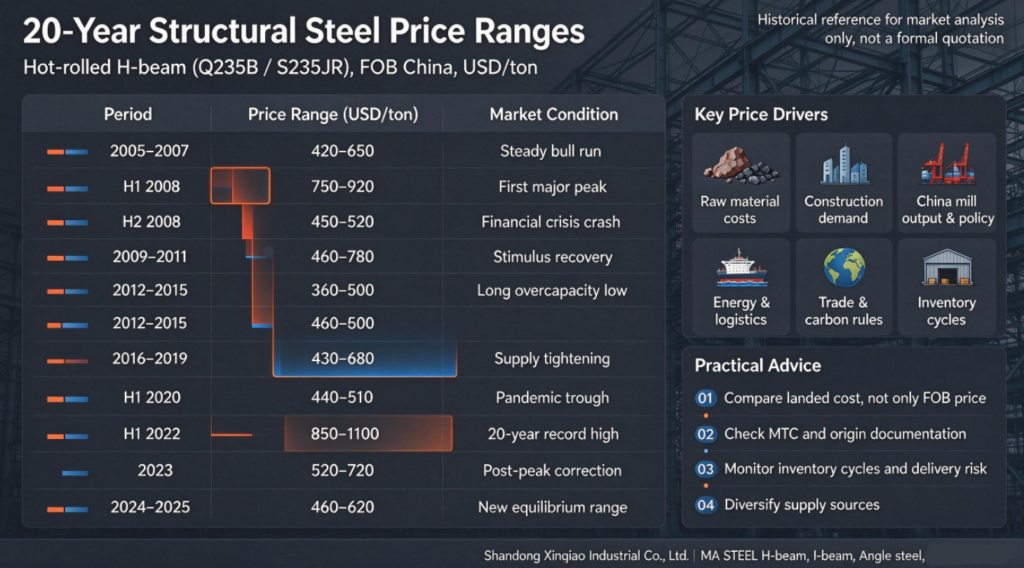
Phase 1: 2005–2008 – Historic Bull Run & All-Time Price Peak
From 2005 to mid-2008, global section steel prices climbed steadily to record highs. The main driver was robust global infrastructure and real estate expansion, especially China’s rapid urbanisation and industrial buildout. Demand surged for H-beams, channel and angle steel for high-rises, bridges, factories and power plants.
Iron ore and coking coal costs rose sharply, as mining capacity struggled to keep up with fast-growing steel production. Global traders and end-users built up safety inventories, further tightening spot markets. By mid-2008, hot rolled structural steel hit its first major multi-decade peak.
The bubble burst quickly after the global financial crisis. In late 2008 and early 2009, construction and manufacturing activity collapsed worldwide. Steel demand evaporated, and section steel prices crashed roughly 40% within months. Mills were forced to cut output and halt blast furnaces, while many buyers stopped new orders and liquidated existing stock.
Phase 2: 2009–2015 – Recovery, Stimulus and Long Overcapacity
Governments launched large infrastructure stimulus packages after the 2008 crisis, which lifted steel demand and prices into a recovery peak around 2011. However, this rebound triggered massive new steel capacity investment globally, especially in China.
From 2012 to 2015, the market entered a long soft period. Global steel capacity far exceeded real demand. Section steel prices trended lower, with frequent oversupply and thin mill profit margins. Iron ore and coal also weakened, and buyers enjoyed relatively stable, low-cost supply for structural sections including H-beams and channel steel. Many steel exporters competed fiercely on FOB prices to secure overseas orders.
Phase 3: 2016–2019 – Supply-Side Reform Lifts Price Base
2016 marked a major turning point. China launched large-scale steel supply-side reform, removing low-quality illegal steel capacity. This quickly reduced global oversupply and lifted steel price floors.
Structural steel prices rose and traded within a higher band compared to the 2012–2015 period. Global construction demand remained steady, and raw material costs stabilised at higher levels. At the same time, trade protectionism started to rise: import tariffs, anti-dumping duties and safeguard quotas created regional price gaps between Asia, Europe and North America. Buyers began to see bigger differences between Asian FOB prices and local domestic steel prices in Western markets.
Phase 4: 2020–2022 – Pandemic Shock, Supply Chain Crisis & Historic Price Spike
The COVID-19 pandemic created a two-stage shock. In early 2020, lockdowns paused construction and manufacturing; section steel prices dipped rapidly to a short-term trough.
But the market reversed extremely fast. Global monetary stimulus and infrastructure plans boosted demand, while port congestion, container shortages and mill production disruptions squeezed supply. Ocean freight rates surged to unprecedented levels.
In 2021 and early 2022, structural steel prices hit another major high. The Ukraine conflict amplified the crisis: energy prices exploded in Europe, coking coal and scrap supplies tightened, and many European steel mills cut production due to unaffordable gas and electricity costs. Supply chain bottlenecks and inventory restocking pushed H-beam and other section steel export prices sharply higher.
Phase 5: 2023–Present – Post-Peak Correction, New Market Equilibrium
After the 2022 peak, global section steel prices trended downward and entered a more stable trading range. Several key factors contributed:
- Slower construction demand, especially China’s real estate adjustment
- Easing supply chain pressure and normalised ocean freight
- Central bank rate hikes, cooling global investment and building projects
- Gradual recovery of mill output as energy costs moderated
Yet the market is not returning to the ultra-low price environment of 2012–2015. New permanent cost factors remain: higher carbon compliance costs, stricter environmental rules, and the EU CBAM carbon border adjustment mechanism. Regional trade barriers still separate markets, creating persistent price differences between Asia, Europe and America.
Core Factors That Shape Section Steel Prices Over 20 Years
1. Raw material costs (the biggest cost driver)
Iron ore, coking coal and steel scrap account for 55–75% of total steel production costs. Any large swing in ore or coal prices directly passes through to H-beam, channel and angle steel FOB prices. Blast furnace steelmakers have limited flexibility to quickly shut or restart production, which amplifies price volatility during commodity shocks.
2. Global construction & infrastructure demand
Section steel is almost entirely used for building frames, bridges, industrial plants and heavy fabrication. Price cycles closely follow global GDP, real estate cycles and government infrastructure spending.
3. China’s steel output and policy
China produces more than half of the world’s steel. Its capacity cuts, energy dual-control rules, export policies and domestic demand shifts instantly change global section steel supply and export prices.
4. Energy & logistics costs
Natural gas, electricity and ocean freight can add massive cost pressure during crises. Even if mill steel price stays flat, total landed cost for overseas buyers can jump sharply due to transport and port charges.
5. Trade barriers and carbon regulations
Tariffs, quotas, anti-dumping measures and carbon border taxes split the global steel market. Buyers now evaluate not only FOB price but also import duties, carbon charges and origin certification. MTC mill test certificates become more critical for cross-border compliance.
6. Inventory cycles
When prices rise, buyers rush to build safety stock and push demand higher. When prices fall, buyers delay orders and run down inventories, accelerating price declines. This inventory behaviour amplifies market swings.
Practical Lessons for Global Steel Buyers
- Section steel is cyclical, not linear. Short-term price spikes rarely last forever; extreme lows also tend to be temporary.
- Landed cost > FOB price. Always calculate freight, duty, carbon tax and inspection fees when comparing suppliers.
- Certified stock reduces risk. Sourcing ready stock with full MTC certification helps avoid delivery delays and compliance risks during supply shocks.
- Diversify supply sources. Regional trade barriers and carbon rules make single-source procurement riskier than before.
About Us
Shandong Xinqiao Industrial Co., Ltd. is a professional supplier of hot rolled section steel: H-beam, I-beam, angle steel, channel steel and flat steel. We maintain ready warehouse stock in Shandong, with complete MTC certificates, flexible cutting service and reliable export delivery for global construction and steel structure projects.
Contact our sales team for current stock list, latest FOB quotation and technical data for S235JR, S355JR, HEA / HEB / HN series H-beams.