A Complete Guide to Structural Steel Section Standards: GB, ASTM, EN, JIS, GOST, KS, BS, AS & More
 By
/ 2026-10-20
When sourcing H beam, I-beams, angle steel and channel steel for cross-border construction projects, understanding regional structural steel standards is critical. Different countries adopt distinct dimension systems, yield strength grades, testing rules and certification requirements. Choosing the correct standard ensures the steel sections fit your design, pass site inspection and satisfy local building codes.
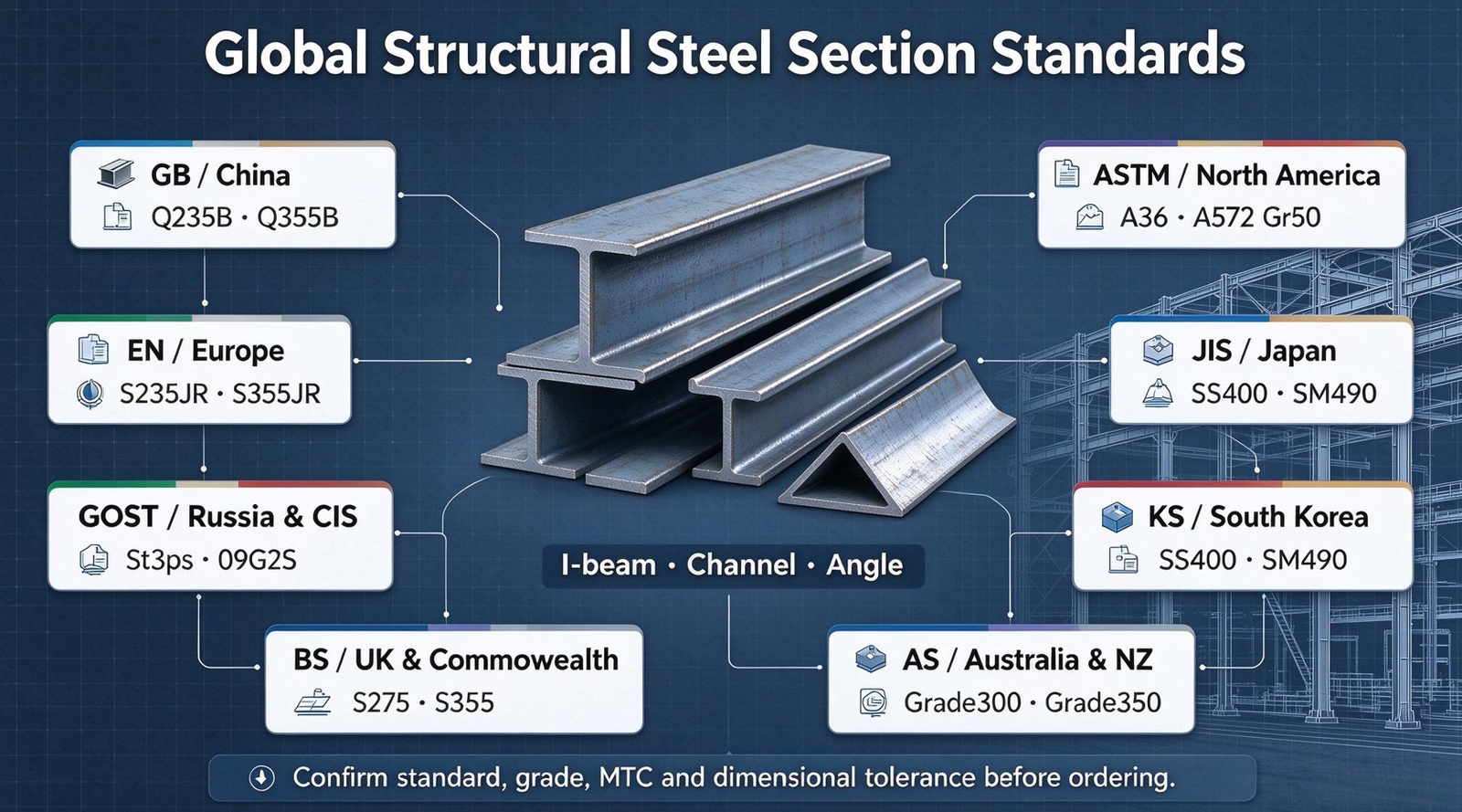
This guide covers the most widely used structural steel standards across the globe, including Chinese GB, American ASTM, European EN, Japanese JIS, Russian GOST, Korean KS, British BS, Australian AS, plus additional widely referenced specifications.
1. GB Standard (Chinese National Standard)
Full name: GB / T national standards for hot rolled sections
- Representative specs:
- GB/T 706: Hot-rolled I-beam and channel steel
- GB/T 700: Carbon structural steel (Q235 series)
- GB/T 1591: High strength low alloy structural steel (Q355 series)
- Common steel grades: Q235B, Q355B
- Features: Metric dimension system. Dimensions, section weight, tolerances defined in GB/T706. Widely used for domestic construction and export projects to Southeast Asia, Africa, Middle East.
- Notes: MTC (Mill Test Certificate) is mandatory for export shipments.
2. ASTM Standard (American Standard)
Issued by ASTM International, widely used in North America, Middle East, Latin America.
- Representative specs:
- ASTM A36: Carbon structural steel
- ASTM A572 Gr50 / Gr42: High strength low alloy steel
- Common shapes: W-beam, S-beam (I-beam), C-channel, L-angle
- Features: Inch-based imperial dimension system. Focus on tensile & yield strength requirements. Popular for US, Canada and Gulf engineering projects.
3. EN Standard (European Norm)
Unified European standard, mandatory for EU countries, also widely accepted globally.
- Representative specs:
- EN 10025: Hot rolled non-alloy structural steel
- EN 10034: I-sections
- EN 10056: Equal & unequal leg angle steel
- EN 10279: Channel steel
- Common grades: S235JR, S355JR, S355NL
- Features: Metric system. Strict CE marking requirement. S355 series is the most popular high-grade steel for European construction.
4. JIS Standard (Japanese Industrial Standard)
Used in Japan, South East Asia, and Japanese overseas investment projects.
- Representative specs:
- JIS G3101: General rolled steel for structure
- JIS G3106: Hot rolled structural steel for welded structure
- Common grades: SS400, SM400A, SM490A
- Sections: H-beam, I-beam, channel steel, equal/unequal angle steel
- Features: Metric system, strict welding & impact test requirements. Frequent for Japanese-funded factories and infrastructure.
5. GOST Standard (Russian Standard)
Used in Russia, CIS countries (Kazakhstan, Uzbekistan, Belarus etc.)
- Representative specs: GOST 8239 (I-beam), GOST 8240 (channel steel), GOST 8509 (angle steel)
- Common grades: St3ps, 09G2S
- Features: Metric system, widely used in Central Asia, Russian domestic construction and energy projects.
6. KS Standard (Korean Standard)
Korean Industrial Standards, used in South Korea and Korean overseas projects.
- Representative specs: KS D 3501, KS D 3502
- Common grades: SS400, SM400, SM490
- Sections: H, I, channel, angle steel
- Note: Similar to JIS system, often adopted for Korean EPC construction projects.
7. BS Standard (British Standard)
Historic UK standard, still used in UK, some Commonwealth countries.
- BS 4: Hot rolled sections
- Common grades: S275JR, S355JR (now largely aligned with EN after European harmonization)
- Note: Old BS 4360 grades are phased out; modern UK projects mostly adopt EN standards.
8. AS Standard (Australian Standard)
Australia & New Zealand building projects.
- AS/NZS 3679: Structural steel hot rolled bars and sections
- Common grades: 300PLUS, Grade300, Grade350
- Features: Australian building code requirement, strict material traceability, widely used for Australian industrial and residential steel frames.
Additional Widely Used Regional Standards
DIN (German Standard)
Old German industrial standard, largely replaced by EN, but many old projects still reference DIN 1025 (I-beam), DIN 1026 (channel).
NF (French Standard)
Previously French national standard, now superseded by EN.
UNI (Italian Standard)
Legacy Italian standard, replaced by EN.
CSA (Canadian Standard)
Canadian CSA G40.20/G40.21, works together with ASTM for North America construction.
Comparison Table (Simplified for Blog)
| Standard | Main Region | Typical Grades | Unit |
|---|---|---|---|
| GB | China, SEA, Africa | Q235B, Q355B | Metric |
| ASTM | USA, Gulf, Latin America | A36, A572 Gr50 | Imperial |
| EN | EU, Global | S235JR, S355JR | Metric |
| JIS | Japan, SEA | SS400, SM490 | Metric |
| GOST | Russia, CIS | St3ps, 09G2S | Metric |
| KS | South Korea | SS400, SM490 | Metric |
| BS | UK, Commonwealth | S275, S355 | Metric (now EN) |
| AS | Australia, NZ | Grade300, Grade350 | Metric |
| CSA | Canada | CSA G40.21 | Imperial/Metric |
How to Choose the Right Steel Standard for Your Project
- Follow project specification: The EPC contractor or structural engineer defines the required standard and grade.
- Check local building code: Some regions only accept locally certified steel (e.g. CE mark for EU).
- Verify MTC: Mill Test Certificate must match the ordered standard and grade.
- Dimension tolerance: Imperial vs metric sections cannot be mixed freely in design.
Conclusion
Global structural steel standards are not interchangeable. Each standard defines unique dimension limits, yield strength, chemical composition and testing protocols. Whether you source GB Q355, EN S355JR, ASTM A36, JIS SS400 or GOST steel sections, confirm the specification before ordering I-beam, angle steel and channel steel.
If you need structural steel sections compliant with global standards with full MTC certification, contact us for technical datasheets and quotations.