How to Fill Out a Correct MTC (Mill Test Certificate) for Steel Sections
 By
/ 2026-11-02
In structural steel export business, the Mill Test Certificate (MTC) is a mandatory document for overseas construction projects, customs clearance and third-party inspection such as SGS or BV. Many buyers and steel traders encounter shipment detention, rejection or claims due to incorrect MTC format, missing fields or mismatched heat numbers.
For hot rolled steel sections including H-beam, HEA/HEB/IPE, equal angle steel, UPN channel and flat bar, the most widely adopted standard is EN 10204 Type 3.1. High-demand projects like offshore engineering and pressure vessels usually require EN 10204 Type 3.2.
⚠️ Important Reminder: An MTC is an official certificate issued directly by the steel mill. Traders are NOT allowed to fabricate or modify test data. Heat Number must fully match the stamping or marking on steel pieces, one heat number for one certificate.
1. EN 10204 Certificate Types You Need to Know
Buyers often only mention “provide MTC” without clarifying the type, which easily causes disputes.
- Type 2.1: Statement of compliance only, no actual test data. Rarely accepted by overseas projects.
- Type 2.2: Report based on batch summary test, not tested for this specific heat.
- Type 3.1: Most common version for steel section export. Issued by independent mill QA inspector, with actual chemical and mechanical test results for this heat, signed and sealed by the steel mill.
- Type 3.2: Based on 3.1, additionally signed and sealed by an independent third-party (SGS / BV / TUV). Used for offshore, pressure vessel and critical engineering projects.
For general steel structure workshops, support frames and common construction projects, EN 10204 3.1 is the standard choice.
2. Standard Structure & Writing Rules for Steel Section MTC
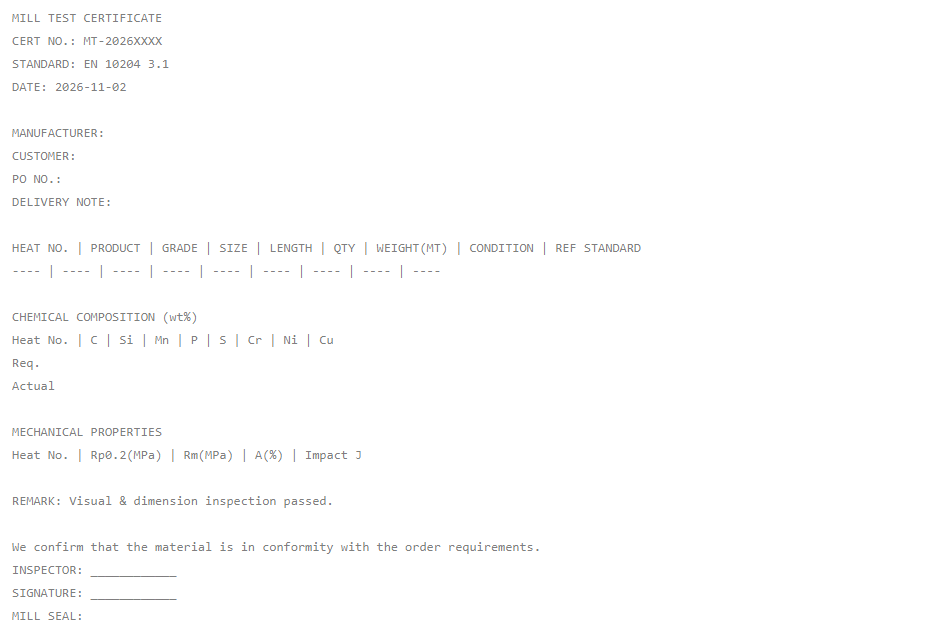
A valid MTC contains 6 parts: certificate header, product schedule, chemical composition table, mechanical properties table, additional inspection items, declaration, signature and mill stamp.
2.1 Certificate Header (Mandatory Basic Information)
MILL TEST CERTIFICATE
Certificate No.:
Standard: EN 10204 3.1
Issue Date:

Manufacturer: HBIS Group
Manufacturer Address:
Customer:
PO No.:
Mill Order No.:
Delivery Note No.:
Writing tips:
- The mill name must be consistent with the mill stamp on the certificate. Avoid vague abbreviations.
- All reference numbers should match your commercial invoice, packing list and bill of lading for easy verification by buyers and customs.
2.2 Product Schedule (Core Traceability Table)
This table links the certificate with physical steel goods. Heat No. is the unique trace code of MTC and must be identical to the marking on steel.
| Heat No. | Product | Grade | Size | Length | Qty | Weight | Mark | Delivery Status | Applicable Standard |
|---|---|---|---|---|---|---|---|---|---|
| H260901 | H-Beam | S355JR | HEB200 | 12m | 12 pcs | 4.256 MT | Pack A01 | Hot Rolled | EN 10025-2 |
Writing tips:
- Product names: H-Beam / IPE / UPN Channel / Equal Angle Steel etc.
- Common grades: S235JR, S355JR, S355J2, Q235B, Q355B, A36, SS400
- Match standards correctly: S355 series → EN 10025-2; Q355B → GB/T 1591; A36 → ASTM A6
- Delivery status: Hot Rolled, Normalized, Q+T (Quenched and Tempered)
2.3 Chemical Composition (wt%)
Rule: Actual test values must be filled in. It is not acceptable to only write “compliant with standard”. Third-party PMI inspection will cross-check these figures.
| Heat No. | C | Si | Mn | P | S | Cr | Ni | Cu | N |
|---|---|---|---|---|---|---|---|---|---|
| Req. | ≤0.24 | ≤0.60 | 0.90~1.65 | ≤0.035 | ≤0.035 | — | — | ≤0.55 | ≤0.012 |
| Actual | 0.17 | 0.32 | 1.31 | 0.018 | 0.007 | 0.04 | 0.02 | 0.16 | 0.008 |
Writing tips:
- Unit: wt% (weight percentage).
- Nitrogen (N) is required for S355 series steel.
- Never copy test data from other heat numbers. Mismatched test data will be treated as fake certificate.
2.4 Mechanical Properties
This is the key reference for structural engineers to calculate load capacity.
| Heat No. | Specimen No. | Yield Strength Rp0.2 (MPa) | Tensile Strength Rm (MPa) | Elongation A (%) | Impact Test | Hardness (Optional) |
|---|---|---|---|---|---|---|
| Req. | — | ≥355 | 470~630 | ≥21 | -20℃ ≥27J | — |
| Actual | T01 | 382 | 541 | 26 | 38,41,36 | — |
Writing tips:
- Rp0.2 (yield) and Rm (tensile) use MPa as unit.
- Impact test at -20℃ is mandatory for S355J2; S355JR normally does not require impact test.
- List results of 3 specimens separately instead of only average value.
2.5 Additional Inspection Items (Optional, as per order requirement)
Dimensional Tolerance: Compliant with EN 10034 / GB/T 706
Visual & Surface Inspection: No surface defects
NDT (UT / MT / PT): Pass (only add if requested by buyer)
2.6 Declaration, Signature & Stamp (Required for valid 3.1 certificate)
Standard declaration text:
We certify that the above test results are true and the products comply with the purchase order and relevant product standards.
Inspector Name: ________
Inspector Title: QA Inspector
Signature: ________
Mill Stamp: Mill official seal
For Type 3.2: Add third-party company name, inspector signature and third-party seal.
3. Choose between English-only or Bilingual MTC
- Europe, Middle East, Australia: English-only MTC (EN10204 3.1) is preferred.
- Southeast Asia and Chinese buyers: Bilingual English & Chinese version for better readability.
- Domestic China market: Chinese version quality certificate following GB/T 18253.
4. Common MTC Mistakes to Avoid in Steel Export
- ❌ Missing heat number, or heat number on certificate inconsistent with steel marking. This is the most frequent issue.
- ❌ Only write “compliant with standard”, without actual chemical and mechanical test data.
- ❌ Trader signs and seals the document as Type 3.1 certificate. Type 3.1 must be signed and sealed by steel mill QA department.
- ❌ Mixed standards: S355 grade marked with GB standard, or Q355B marked with EN 10025.
- ❌ Mix multiple heat numbers in one single row without separate tables.
- ❌ Signed by sales staff instead of independent QA inspector.
5. FAQ
Q1: Is MTC the same as MTR?
A: In steel export industry, MTR (Mill Test Report) and MTC (Mill Test Certificate) refer to the same document. MTC is the more widely used term.
Q2: What extra content is needed for Type 3.2 MTC?
A: Based on full 3.1 content, samples are witnessed and tested by third-party surveyor (SGS/BV/TUV). The third-party inspector will sign and stamp the certificate. It is used for critical high-risk projects.
Q3: Can we put multiple steel types (angle steel + H beam) in one MTC?
A: Yes. But you must separate them by heat number in different rows. Different heat numbers cannot be merged into one line. Heat number, weight and specification must correspond one by one.
Q4: Do we need to send hard copy original MTC together with cargo?
A: Most overseas buyers accept PDF file with official electronic mill seal nowadays. Some projects require wet-ink hard copy sent together with bill of lading. Confirm this requirement with your buyer before production.
Conclusion
A standard MTC is far more than a shipping document. It proves quality traceability and builds trust with your structural steel buyers. For H beams, angle steel, channel steel and other export steel sections, following EN 10204 rules and ensuring traceable heat numbers helps you reduce trade disputes and win long-term project orders.
Contact us if you need an editable MTC template for steel sections.